.svg)
The Quantum Security Problem Is Not “Far Future” Anymore
What this means
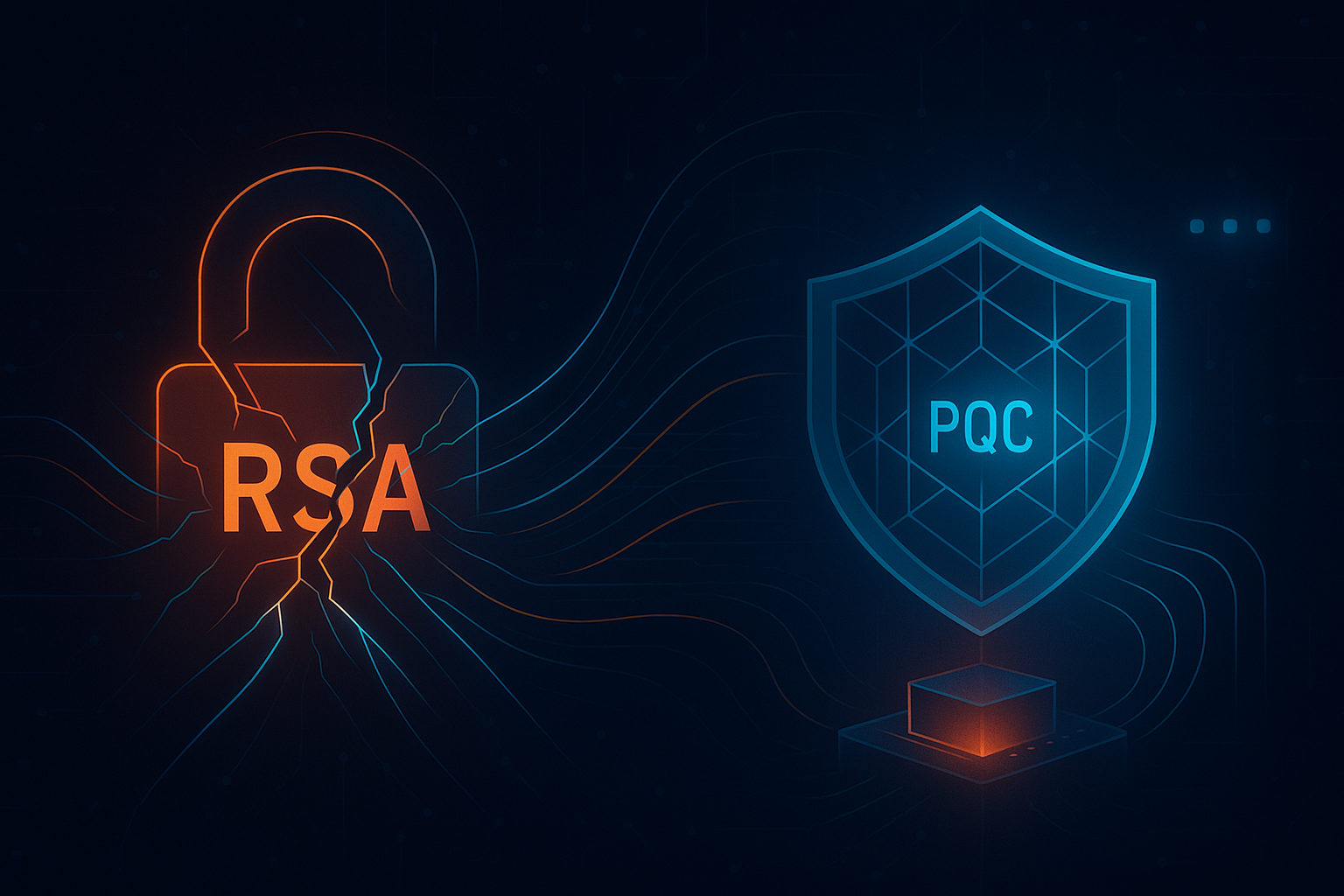
RSA / ECC can be broken by a sufficiently large, fault-tolerant quantum computer running Shor’s algorithm—so the risk horizon is the lifetime of your data, not the arrival date of that machine.
NIST finalized three post-quantum cryptography (PQC) standards—FIPS 203 (ML-KEM), FIPS 204 (ML-DSA), and FIPS 205 (SLH-DSA / SPHINCS+)—on August 13 2024. The “wait for standards” window is closed.
Harvest-now, decrypt-later (HNDL) means adversaries can record cipher text today and decrypt it later; CISA and NIST urge organizations to begin inventory and migration planning now.
The quantum threat isn’t hypothetical anymore
Public-key cryptography that underpins TLS, VPNs, code-signing, and identity (RSA/ECC) relies on factoring and discrete-log problems. Shor’s algorithm shows these can be solved in polynomial time on a quantum computer—and that fundamentally breaks those schemes once sufficiently large machines exist. The prudent clock is set by your data lifetime and adversary intent, not by a speculative “Q-day.”
Why this matters practically: if an attacker copies your encrypted traffic or archives today, those assets can be retro-decrypted later—exactly the HNDL pattern driving urgency in critical-infrastructure guidance.
“We’re waiting for standards” is no longer credible
NIST completed the first wave of PQC standards on August 13 2024, after years of public cryptanalysis and evaluation:
- FIPS 203 – ML-KEM (Kyber) for key establishment
- FIPS 204 – ML-DSA (Dilithium) for digital signatures
- FIPS 205 – SLH-DSA (SPHINCS+) as a hash-based signature alternative
The NIST CSRC portal documents scope, security goals, and publication details—giving enterprises green-light clarity to proceed.
NIST IR 8545 (2025) maps near-term guidance and next steps, reinforcing that the migration runway is active now.
Harvest-Now, Decrypt-Later (HNDL): why “later” is already “now”
HNDL reframes quantum risk as an immediate exposure for long-lived secrets (IP, legal archives, PII, PHI, nation-state-sensitive data). U.S. agencies advise organizations to start with automated discovery and inventory to locate quantum-vulnerable cryptography and long-lived encrypted stores—because you can’t protect what you can’t see.
Bottom line: if the useful lifetime of an asset exceeds the likely window to viable quantum decryption, treat it as at-risk and prioritize it.
Policy signals: national security timelines are pulling the market forward
The NSA’s CNSA 2.0 Program sets quantum-resistant expectations for National Security Systems and communicates migration urgency. Public guidance and FAQs highlight the direction of travel and transition expectations; downstream, commercial sectors are aligning roadmaps and audits to the same north star.
Business impact: why quantum-safe migration starts today
Data liability: Captured ciphertext that’s sensitive for 5–10 years (IP, M&A, health records) can become plaintext after Q-day. Boards and regulators will ask why you waited post-standards.
Operational complexity: PQC migration touches protocols, libraries, certificates, code-signing, machine identities, and archives. CISA and NIST recommend discovery first, then prioritized rollouts.
Compliance posture: Documented progress toward PQC (coverage %, hybrid enablement %, signing posture) will increasingly show up in audits and vendor attestations as CNSA 2.0 and NIST guidance ripple through supply chains.
What changed—technically—in the last 18 months
Standards aren’t the only shift. The ecosystem has moved:
- NIST finalization (Aug 2024) enables procurement and policy to reference stable identifiers. (CSRC FIPS 203/204/205)
- Agencies emphasize automated discovery/inventory to baseline posture across federal enterprises—mirroring what private-sector CISOs must do now.
These aren’t hype signals; they’re the building blocks for enterprise roadmaps.
How to Act Now — Without Breaking Things
The path to quantum safety doesn’t start with tearing everything down — it starts with visibility and intelligent sequencing.
Discover. Every migration begins with knowing what you’re protecting. Our Crypto Inventory Engine automatically maps your cryptography across endpoints, libraries, certificates, machine identities, and archives — revealing long-lived, HNDL-exposed assets that manual audits miss.
Assess. From there, our AI-driven triage ranks what matters most — combining data half-life, business impact, and compliance urgency to build a clear remediation plan aligned with NIST’s finalized PQC standards (FIPS 203, 204, 205) and CNSA 2.0 timelines.
Protect. We implement hybrid encryption (classical + PQC) and dual-signing rollouts with safe rollback paths, ensuring operational continuity while advancing toward full quantum-safe adoption.
Monitor. Finally, real-time dashboards track handshake integrity, signing posture, and re-encryption progress, producing audit-ready reports mapped to NIST IR 8545 — evidence your board and regulators can trust.
Quantum Solutions makes quantum migration achievable: a single, automated platform to discover, assess, protect, and continuously verify your readiness.
Get Ahead of the Standards
Quantum computing is moving faster than policy — but the standards are already here.
Quantum Solutions helps enterprises transition safely, prove compliance, and stay aligned with the world’s evolving cryptographic requirements.
Learn more on how to get ahead of changing global standards.